







🤜🤛 Expand and Enrich Your Partner Network with a Partner Discovery Platform
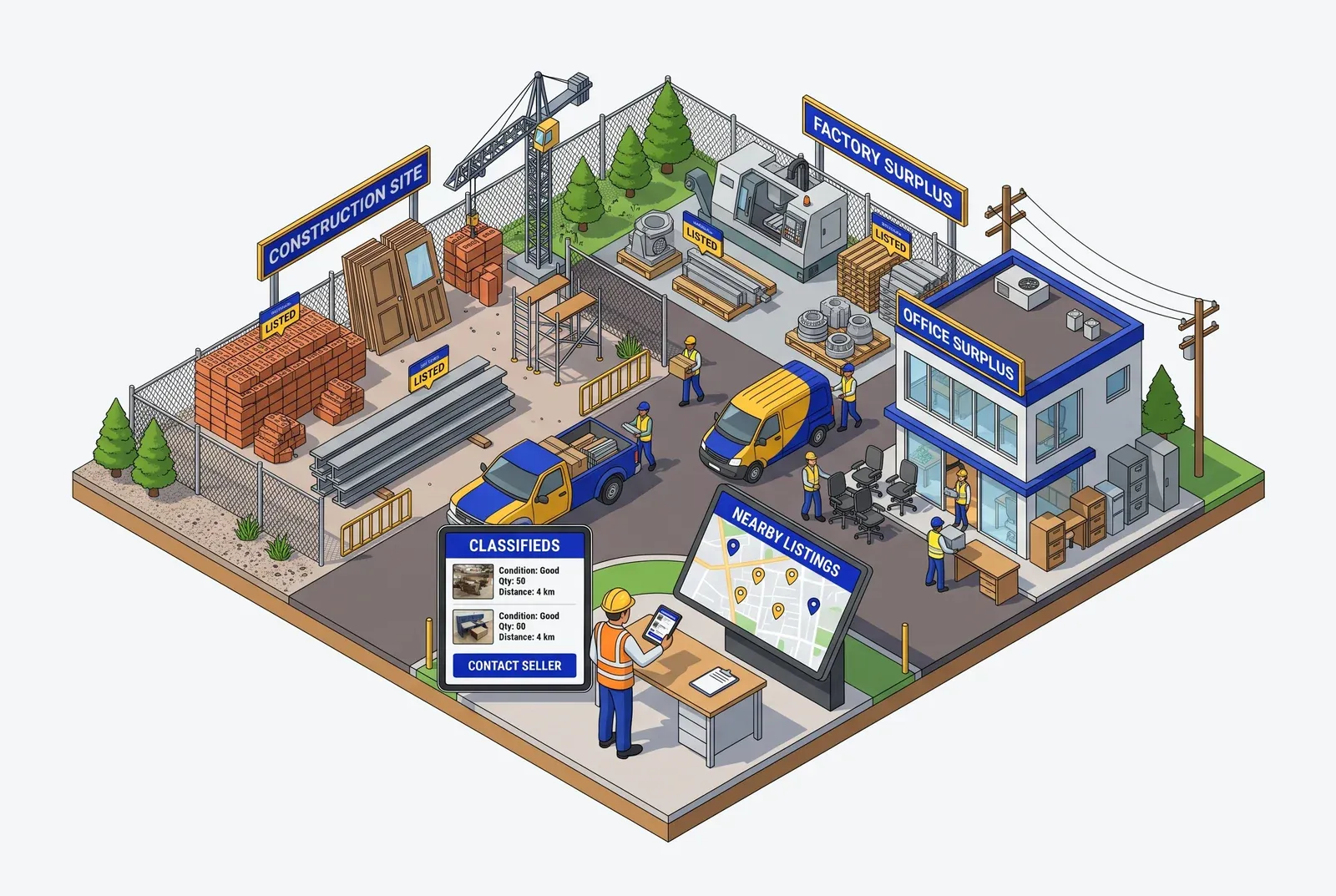
Isometric industrial area where a construction site, a factory yard and an office list surplus bricks, steel beams, machines and furniture, while a site manager browses nearby listings on a tablet and vans collect the items

B2B reuse marketplace

Give surplus equipment and materials a second life between companies

Companies list used machines, surplus building materials, office furniture and any other item they no longer need, and nearby professionals contact them to take it. There is no basket and no stock: each listing leads to a direct exchange between two companies.

📅 Book a demo
IntersportGS1 FranceThalesEDFAccorSuezAllianzSiemens EnergySaint-Gobain
The model

What each party gets

Who asks
Professional buyers
A builder finds reusable bricks and doors 20 km from the site, instead of ordering new ones and waiting for delivery.
→
Who sets the rules
The network operator
A federation, a large group or a public body keeps reuse inside its network, and can show how many items found a second life.
→
Who delivers
Companies with surplus
A company with spare equipment lists it in minutes and frees storage space, instead of paying to have it taken away.
The reuse rule
Used goods are local and one of a kind: each item exists once, in one place, so a listing only works if a nearby buyer sees it and collects it quickly.

What changes

What changes for buyers, sellers and the network

For you
Today
With Second
Surplus found before it is thrown away
A site manager pays for a skip to remove materials that another site could have used.
The site manager lists the materials, and a nearby company comes to collect them.
Items found close to the job
A buyer searches several general classifieds sites and finds the right item 500 km away.
The buyer filters by category, condition and distance, and sees only listings within reach.
Trust between professionals
A buyer cannot tell whether the seller is a real company or whether the item matches the photo.
Every seller is a verified company, and both sides rate each exchange.
Reuse the network can measure
The network cannot say how many items its members reused last year.
The network sees listings, exchanges and categories, and reports the reuse its members achieved.
How it works

From a surplus item to its next user

1. Companies join and are verified

Each company proves its identity once, then lists items and contacts sellers under its own account.
How: Vendor network →

2. Items are listed with the same details

Each listing states the category, condition, quantity, location and photos, so buyers compare like with like.
How: Service information →

3. Buyers find items nearby and get in touch

A buyer filters by distance and condition, then contacts the seller to agree on the price and the collection.
How: Service marketplace →

4. The network grows reuse where it works

Listings show which categories move fastest in which areas, so the network invites more members there first.
How: Partner discovery →
Proof

Proven where idle equipment and waste find new use

WeFarmUp
Agriculture · equipment sharing

WeFarmUp

Farmers put idle machinery back to work between peers, with availability by zone, deposits and two-way ratings.

Read the case study
Suez
Waste · circular services

Suez — Valoservices

Suez opened its waste services platform to vetted third parties, and now covers the whole of France.

Read the case study
Before you start

Four questions to settle first

Answer these four questions first. Everything else is configuration.

1. Which items may be listed?

Decide which categories you accept, such as equipment, materials, furniture and any other item your members no longer need.

2. Who may list and who may buy?

Decide whether only members, any verified company or also individuals can list items and contact sellers.

3. How far should an item travel?

Decide the search radius and the collection rules, so items stay local.

4. Is money involved?

Decide whether items are given away or sold at a price agreed between companies, and whether sellers pay a subscription to list.
FAQ

Frequently asked questions

What is a B2B reuse marketplace?

It is a platform where companies list the equipment and materials they no longer need, and other professionals find and collect them. Each listing leads to a direct exchange between two companies.

Does the platform handle a basket or stock?

No. Each listing describes one item or one batch, and the buyer contacts the seller. There is no basket, no stock and no delivery run by the platform.

Can only verified companies take part?

Yes. Each company proves its identity before listing or contacting a seller, and both sides rate each exchange.

Can buyers search by distance?

Yes. Buyers filter listings by category, condition and distance, so they only see items they can collect.

Can the platform connect to our existing systems?

Yes. Your applications connect to the platform through its REST API. Once integrated, buyers can also reach the platform from their purchasing system by punchout.

How does the operator earn?

The operator can charge sellers a subscription to list items. The price of each item is agreed directly between the two companies.

Combine solutions and unlock unlimited capabilities:

Service information management

One structured catalogue: categories, attributes and pricing rules the operator defines.

Catalogue
+
Vendor network management platform

Recruit, verify, structure and monitor the providers who sell through your platform.

Vendors
+
Partner discovery platform

Let members of a network find certified partners, compare them and make contact directly.

match
Discover our composable
‍
Suite for Services
Fit-gap analysis
Contact a solution specialist
Our solutions for services:

Service marketplace platform

Run a marketplace where providers sell services: availability, quotes, and payment tied to execution.

markEtplace
Services procurement platform

One place to source, compare and order services from approved suppliers, under agreed conditions.

ECOSYSTEM
Partner discovery platform

Let members of a network find certified partners, compare them and make contact directly.

match
Request for quote platform

Turn customer requests into qualified leads: one quote request, or an RFx sent to several providers.

RFQ
Service information management

One structured catalogue: categories, attributes and pricing rules the operator defines.

Catalogue
Vendor network management platform

Recruit, verify, structure and monitor the providers who sell through your platform.

Vendors