







🤜🤛 Expand and Enrich Your Partner Network with a Partner Discovery Platform

RFQ software and RFx platform

Turn customer requests into qualified leads for your providers

Second collects structured requests from customers and puts qualified providers in front of them. RFQ, RFI and RFP are three shapes of the same thing — a buyer describes a need and the market answers — and Second handles all three, plus one-to-one quote requests sent to a single provider.

📅 Book a demo
IntersportGS1 FranceThalesEDFAccorSuezAllianzSiemens EnergySaint-Gobain
Definition

What a request for quote platform is

A request for quote platform is the software an operator uses to handle demand where price is not known in advance. Instead of picking a listing, the customer describes a need — a renovation, a maintenance job, a consulting engagement. The platform routes it to the right providers, collects their quotes or bids, and lets the customer compare and choose. Each routed request is a lead. How leads are paid for is the operator's decision.

Four parts, from the request received to the offer accepted.

Quote request

On a provider's listing: title, description, files, date, location, a message thread, then acceptance.

Request for proposal

A need published to several providers at once, with categories, documents, execution dates and expiry.

Routing & matching

Providers notified by category and, with AI matching, by profile, rating and distance.

Monetisation

Commission on the resulting transaction, provider subscription, fee per lead, or a mix.

It runs quote-based marketplaces for home services, building trades, industrial maintenance, professional services and B2B service networks. The pattern holds wherever a price cannot be published in advance.

Demand side

Why quote-based services need their own platform

Lead generation sites sell contact details. A request for quote platform structures the request, the answer and the outcome. Four things change.

Demand arrives badly formed

A homeowner knows the bathroom needs work, not which trade they need. The platform must qualify the request before routing it.

The right provider is a match, not a list

Category, territory, availability and track record decide who should receive the request. Sending it to everyone destroys value for all.

The answer is an offer

A quote has a scope, a price and conditions. Comparing offers requires a structure, and a place to negotiate.

The outcome is the metric

Whether the job was booked, done and paid is what tells the operator a lead was real. That data has to live on the platform.
Contact us

Talk to a
Solution Engineer

Thank you for reaching out!

we will get back to you very shortly.

Every SCND" counts!
our apologies, an error occurred :-/
Please contact us on hello@scnd.com
Use cases

Three ways operators use quote requests

01

Qualify consumer demand for a trade

Route homeowner requests to qualified craftspeople. 360 Travaux, built by CAPEB, references 12,500 craftspeople with qualification visible on every profile.

02

Price on request at scale

Open a marketplace where price depends on the job. Suez opened Valoservices to competitors and subcontractors across France, with real-time pricing driven by waste type, volume and location.

03

Run structured tenders

Publish a requirement to certified suppliers and compare bids. Siemens Energy's BidBrella runs industrial maintenance tenders with a sequenced RFI/RFP workflow.

Whether a request goes to one provider or to several decides most of the model.

Method

Structure the request model before opening the platform

A quote platform fails when requests are vague, routing is too wide and outcomes are invisible. So those three are settled before anything is configured, and the answers become configuration.

1. What must a request contain?

What makes a request answerable. The operator sets mandatory fields per category, along with files, dates and location, so a provider can price the job without a phone call first. The same fields are what turn a request into a qualified lead rather than a name and an email address.

2. Who receives it, and how many?

Where the request goes. The customer can choose one provider, or the platform can match several. The operator sets the maximum number of recipients, the criteria used to rank them — profile, ratings, distance — and lets providers opt out of requests they do not want.

3. How are offers compared and accepted?

How the answer comes back. A quote or a bid follows a structure the operator defines, and can be negotiated, accepted or declined before it expires. Whether a customer may accept more than one offer is an operator decision, and it changes the economics of the page.

4. Who pays for what?

How the operator is paid. A fee per routed lead, a commission on the resulting transaction, a provider subscription, or a mix — a quote platform can charge either side. Payment on the transaction itself may then run through the platform, or not at all.
Platform

What Second provides — the request, the answer and the outcome

Quote request

Mandatory title and description, optional files, date and location; a message thread; statuses through to payment.

Request for proposal

Multi-category RFP with media, documents, execution dates and expiry; bids compared, then accepted, negotiated or declined.

AI vendor matching

Providers notified by profile, ratings and geolocation, with an operator-set maximum per request.

RFP assistant

A conversational assistant that collects missing details and pre-fills the request, including from uploaded documents and photos.

Provider plans

Platform subscriptions with plans, for pay-to-receive or premium visibility models.

Payment after acceptance

Pay-in, escrow, split and payout through the operator's payment provider once a quote is accepted.

Proof

Three request models, one platform

360 Travaux by CAPEB
Building trades · consumer requests

360 Travaux — CAPEB

France's first renovation marketplace designed by and for the building trades. 12,500 craftspeople referenced, 4,500 registered on launch day.

Read the case study
Suez
Utilities · price on request

Suez — Valoservices

From direct sales to an open B2B and B2C services marketplace covering all of France: real-time pricing, unified payments, full KYB. Live in seven months.

Read the case study
Siemens Energy
Industry · tenders

Siemens Energy — BidBrella

A B2B tendering marketplace for industrial maintenance: certified-supplier access, sequenced RFI/RFP workflow, decision cockpit. MVP live in eight weeks.

Read the case study
Trajectory

From request model to live platform

Scoping

Request types, mandatory fields, routing rules, monetisation. Output: a documented request model.

Configuration

Categories, quote and RFP flows, matching parameters, payment set-up.

Pilot

One category or one territory, with real requests and providers.

Roll-out

All categories, provider plans, operator dashboards.
FAQ

Frequently asked questions

What is the difference between a request for quote platform and a lead generation site?

A lead generation site sells contact details and stops there. A request for quote platform structures the request, routes it to qualified providers, collects offers and records the outcome. The operator can monetise the lead, the transaction, or both. In Second the request layer is licensed on its own.

How is a request routed?

By category and location, to one provider chosen by the customer or to several. With AI vendor matching, providers are ranked by profile, ratings and distance, with a maximum set by the operator.

Can providers pay per lead?

The platform supports commission on transactions, provider subscriptions with plans, and fee-based models. The right mix is decided in scoping and configured — not developed.

Can quote-based and fixed-price services coexist?

Yes. Second classifies services by rendering type. Flat-rate, time-based and seat-based services are booked directly; quote request and RFP types collect offers first.

Does payment run through the platform?

It can. Once a quote is accepted, pay-in, escrow, split and payout run through the platform's payment provider. It can also be switched off for B2B engagements settled outside the platform.

How does the platform keep providers from taking the deal off-platform?

Escrow and refunds, verified identities, reviews that build reputation, and moderation of contact details in messages make the platform the safer and cheaper place to transact.

Combine solutions and unlock unlimited capabilities:

Service information management

One structured catalogue: categories, attributes and pricing rules the operator defines.

Catalogue
+
Vendor network management platform

Recruit, verify, structure and monitor the providers who sell through your platform.

Vendors
+
Partner discovery platform

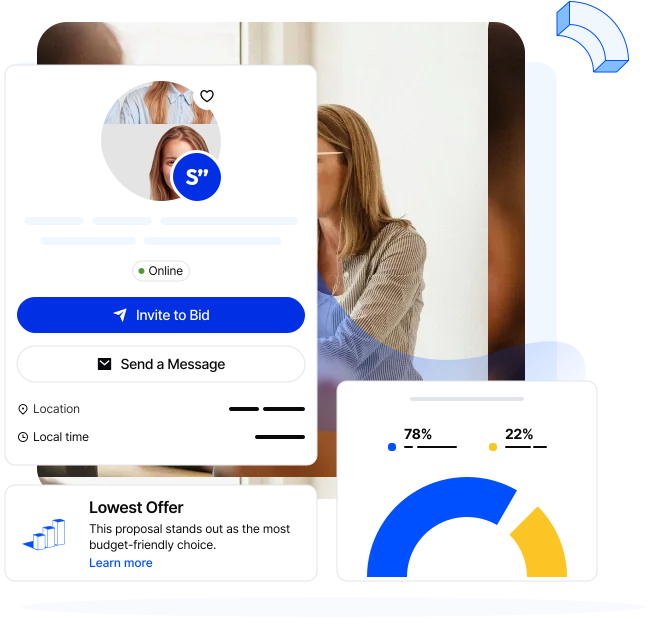
Let members of a network find certified partners, compare them and make contact directly.

match
Discover our composable
‍
Suite for Services
Fit-gap analysis
Contact a solution specialist
Our solutions for services:

Service marketplace platform

Run a marketplace where providers sell services: availability, quotes, and payment tied to execution.

markEtplace
Services procurement platform

One place to source, compare and order services from approved suppliers, under agreed conditions.

ECOSYSTEM
Partner discovery platform

Let members of a network find certified partners, compare them and make contact directly.

match
Request for quote platform

Turn customer requests into qualified leads: one quote request, or an RFx sent to several providers.

RFQ
Service information management

One structured catalogue: categories, attributes and pricing rules the operator defines.

Catalogue
Vendor network management platform

Recruit, verify, structure and monitor the providers who sell through your platform.

Vendors