Back to Customers
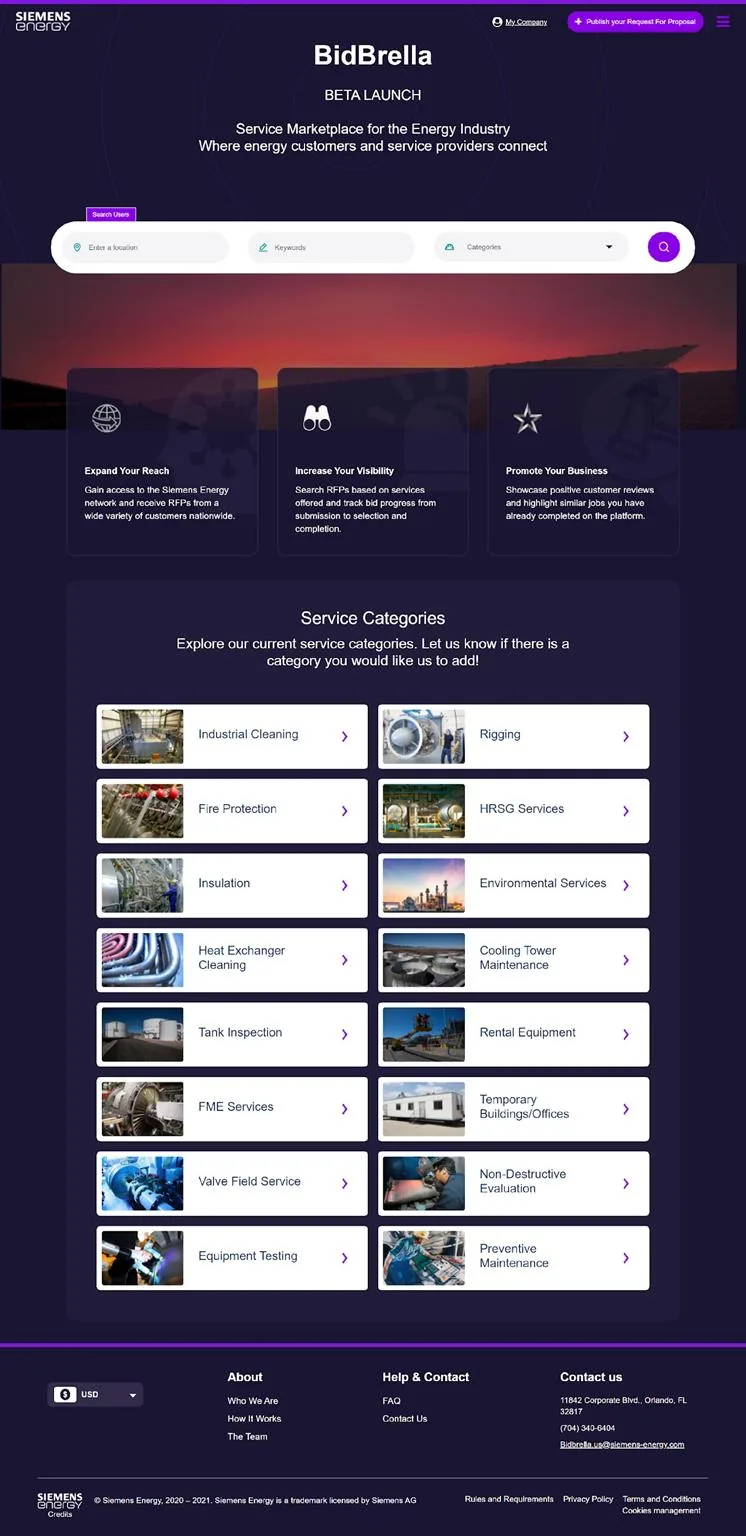
BidBrella: structuring industrial tendering for Siemens Energy
A B2B tendering marketplace for industrial maintenance — sequenced RFI/RFP workflow, certified-supplier access, decision cockpit. MVP live in eight weeks.

A B2B tendering marketplace for industrial maintenance — sequenced RFI/RFP workflow, certified-supplier access, decision cockpit. MVP live in eight weeks.
Overview
Siemens Energy manufactures and maintains power generation equipment worldwide. Its customers regularly need maintenance work carried out on that equipment, and qualified engineering firms are available to do it. What did not exist was a structured way to bring the two together. Requests circulated through email threads, individual relationships and documents exchanged outside any common system. Every tender was run from scratch, and nobody could see, across the organisation, which suppliers had responded to what, how quickly, or how well the work had gone.
Challenge
An industrial tender is not a transaction. It is a sequence: publish a requirement, identify suppliers certified to do the work, exchange technical documents securely, answer questions, receive and compare proposals, award. Each step carries constraints a generic marketplace does not handle. Suppliers must hold specific ISO and HSE certifications. Technical questions need a traceable answer channel, not a side conversation. And the exchange of engineering documents in an industrial environment has its own security requirements. Siemens Energy needed the sequence itself to become a product.
Publish, qualify, exchange, answer, compare, award — six steps that had lived in email threads. Six capabilities carry them on BidBrella.
BidBrella runs tenders as a sequence — requirement, qualified suppliers, documents, questions, proposals, award — so every tender follows the same structure instead of being rebuilt from scratch.
Technical questions run through a structured Q&A channel. Every clarification is recorded against the tender it belongs to — traceable, rather than lost in a side conversation.
Supplier matching is driven by engineering criteria: technical competencies, geographic coverage, ISO and HSE certifications. A requirement published in one region reaches the suppliers actually qualified to serve it.
Only providers labelled by Siemens Energy can respond. Non-conforming suppliers are excluded automatically rather than filtered manually after the fact.
Response rates by tender, post-mission supplier evaluations and geographic heatmaps showing where supplier coverage is thin — the organisation-wide view that did not exist before.
The MVP went live eight weeks after the project started, from nothing — deliberately, to put a working tendering cycle in front of real users and enrich it from operational feedback rather than assumptions.
The platform handles high-complexity B2B transactions in an industrial environment where the cost of a badly matched supplier is measured in plant downtime. What was scattered across email threads is now a sequenced, traceable tendering cycle with an organisation-wide view of supplier performance.
BidBrella turns the tendering sequence into a product. Three Second modules carry it.
Industry use case: Industrial services →





















Run a marketplace where providers sell services: availability, quotes, and payment tied to execution.


One place to source, compare and order services from approved suppliers, under agreed conditions.

Let members of a network find certified partners, compare them and make contact directly.

Turn customer requests into qualified leads: one quote request, or an RFx sent to several providers.

One structured catalogue: categories, attributes and pricing rules the operator defines.

Recruit, verify, structure and monitor the providers who sell through your platform.