Back to Customers
Aquagir and Numérique360: two B2G platforms for local authorities
Two business-to-government marketplaces for Banque des Territoires — 450+ providers onboarded, and a search engine rebuilt around how public buyers actually decide.

Two business-to-government marketplaces for Banque des Territoires — 450+ providers onboarded, and a search engine rebuilt around how public buyers actually decide.
Overview
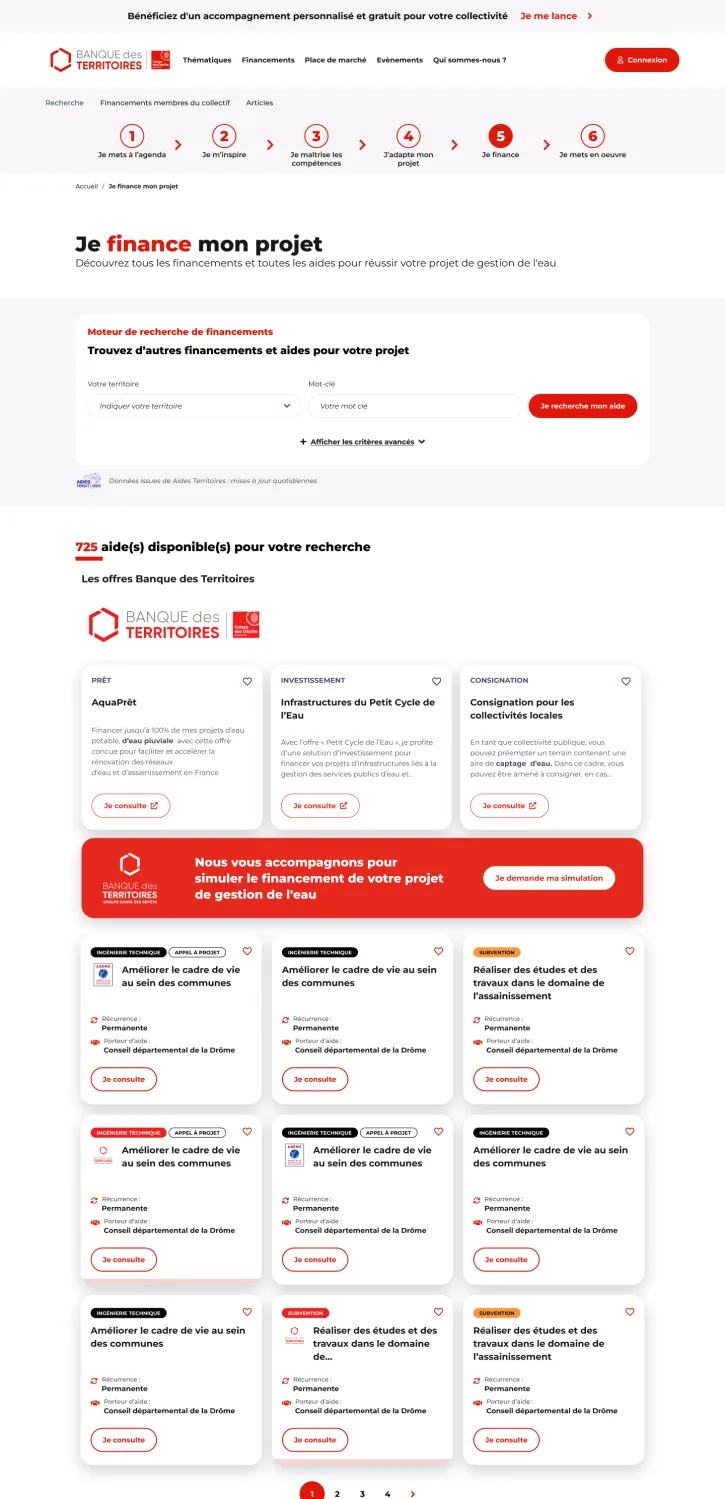
Banque des Territoires finances and supports French local authorities. It operates two business-to-government marketplaces, built on Second: Aquagir, covering water management, and Numérique360, covering digital support for local authorities. Both needed to work harder. Two design engagements followed: a conversion diagnosis across the two platforms, then a rebuild of the search engine on Numérique360.
Challenge
Public buyers do not behave like private ones, and a platform built on private-sector assumptions leaks conversions without anyone being able to say why. A local authority is bound by public procurement law. It does not start by requesting a quote. It starts by looking for references and peer feedback — what did a comparable authority do, with whom, and did it work. Only then does the procurement process begin. A funnel designed around “request a quote” therefore asks the buyer to do the last step first. The task was to align the platform experience with how public buyers actually decide.
Building the platforms was the first half of the work. Making them convert with public-sector buyers was the second. Six pieces carry both.
Aquagir for water management, Numérique360 for digital support to local authorities. Both were designed and developed end to end for Banque des Territoires — model, experience and platform — rather than assembled from a generic template.
Catalogue structuring, listing qualification and publication across the two platforms. This is the unglamorous work that determines whether a marketplace has anything worth searching — and it was done before conversion was measured.
A UX diagnosis on Aquagir traced where public buyers dropped out. The conversion path was then reworked around public-sector decision behaviour: references and peer feedback first, procurement steps after.
The search engine was rebuilt around a cross-cutting architecture that unifies three content types that had been separate: offers, editorial content and provider listings. A buyer researching a subject and a buyer looking for a supplier now travel the same structure.
A local authority cannot start with a quote request. The journey was aligned with the legal sequence — research, comparable references, then procurement — so the platform asks for the right step at the right moment.
The two engagements ran from diagnosis to delivered rebuild in six months and generated more than 70 days of development backlog — a measure of how much of the work was structural rather than cosmetic.
Aquagir reaches 12,000 visits a month since launch. Two B2G platforms now follow the way local authorities actually decide, with a unified search on Numérique360 and a provider base of more than 450 qualified listings — taken from diagnosis to delivery in six months.
Platform: aquagir.fr
Aquagir and Numérique360 had to be built, then made to convert with public buyers. Three Second modules carry them.
Industry use case: Public sector →





















Run a marketplace where providers sell services: availability, quotes, and payment tied to execution.


One place to source, compare and order services from approved suppliers, under agreed conditions.

Let members of a network find certified partners, compare them and make contact directly.

Turn customer requests into qualified leads: one quote request, or an RFx sent to several providers.

One structured catalogue: categories, attributes and pricing rules the operator defines.

Recruit, verify, structure and monitor the providers who sell through your platform.