Back to Customers
OPCO 2i: a national training marketplace for 3 million employees
Building a national vocational training hub for 29 industry branches on Second — AI-driven predictive search, LHEO compliance, automated group enrolment.

Building a national vocational training hub for 29 industry branches on Second — AI-driven predictive search, LHEO compliance, automated group enrolment.
Overview
OPCO 2i is the French skills operator for interindustry sectors. It covers vocational training for 29 professional branches and roughly three million employees — a mandate funded by employer contributions and governed jointly by employers and unions. The training offer existed. Reaching it did not work. Courses were scattered across providers, catalogues were unreadable for small and mid-sized companies, and enrolments were entirely manual. The practical consequence was that allocated training budgets were under-consumed: money set aside for skills development was not converted into training, because the path from a company's need to an available course was too long.
Challenge
Three constraints had to hold at once. Training data in France follows the LHEO standard, so any catalogue that is going to interoperate with the wider ecosystem has to speak it. A national catalogue is only useful if training is findable close to where employees actually are. And enrolling a group of employees — not one learner, a group — has to take minutes rather than a week of back-and-forth. There was a fourth constraint that shaped everything: OPCO 2i already runs a CRM and an ERP. A parallel system that did not talk to them would have created reconciliation work instead of removing it.
OPCO 2i needed the whole chain — find, compare, enrol, certify — to become a product. Six capabilities carry that chain on Second.
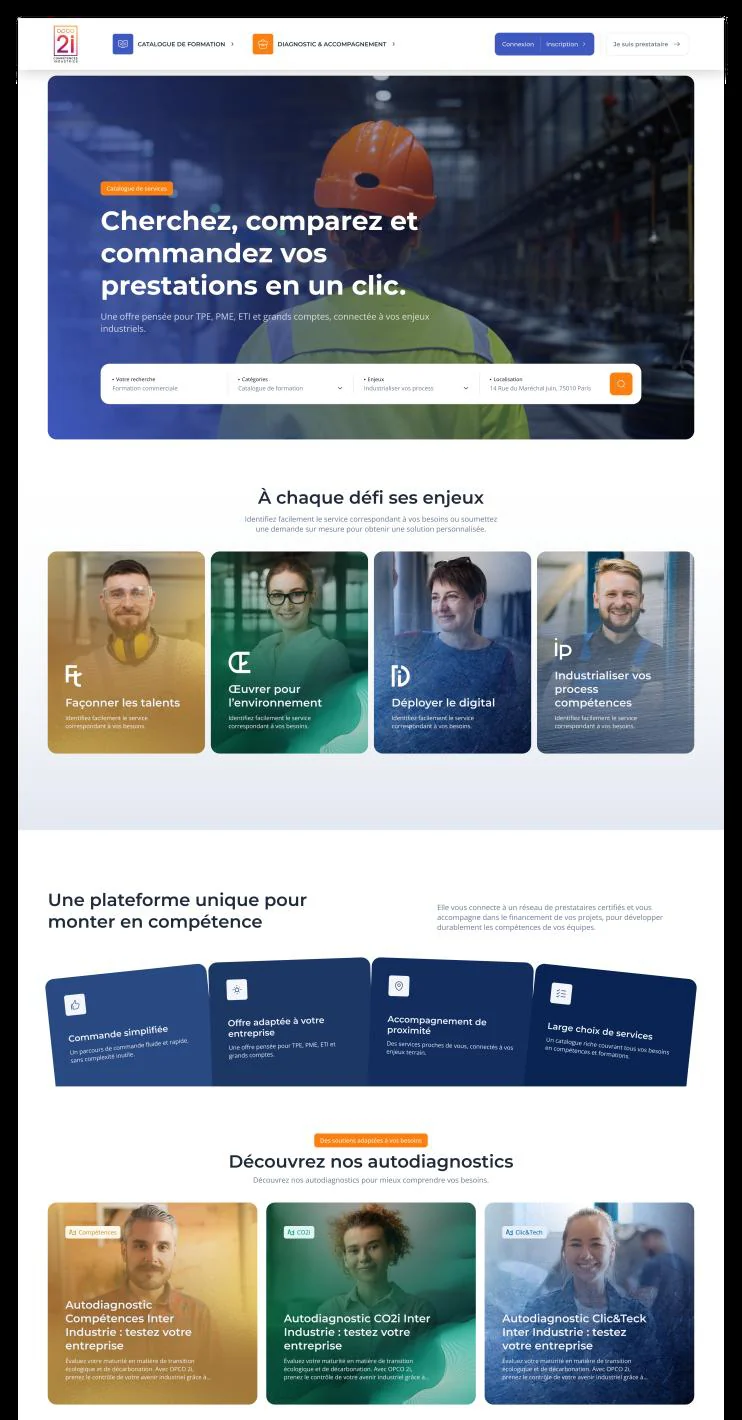
The national catalogue is built around predictive search. A company describes a need in its own words and the platform proposes the relevant courses, sessions and providers — instead of asking the user to navigate a taxonomy they do not know. For a small manufacturer with no training department, that is the difference between using the budget and leaving it on the table.
Training data in France is exchanged in the LHEO standard. The catalogue speaks it natively, so every course record is interoperable with the wider ecosystem — regional bodies, national registries, provider systems — without a translation layer bolted on later.
A “near me” view puts an interactive map and the sessions actually available nearby in front of the user. Proximity is a first-class search criterion: a national catalogue is only useful if the training is reachable from where the employees are.
Enrolling employees is a group action, not a one-learner form. Companies register groups in a few clicks through an automated funnel, synchronised with the national Mon Compte 2i personal space — replacing a week of emails with a few minutes.
Certificates and training records are centralised in a secure vault, with alerts when critical competencies approach renewal. Compliance stops being a periodic audit and becomes a continuous signal the company can act on.
OPCO 2i already runs a CRM and an ERP. The platform integrates with both: data and secure identities are synchronised rather than duplicated, so the hub removes reconciliation work instead of creating it.
OPCO 2i moved from a dispersed training offer to a single national hub with a potential reach of three million employees across 29 branches — where finding, comparing and enrolling in training is a platform function instead of an administrative process. The budgets that went unspent because the path was too long now have a short path.
Platform: services2i.opco2i.fr
OPCO 2i needed the whole chain — find, compare, enrol, certify — to become a product. Three Second modules carry it.
Industry use case: Training →





















Run a marketplace where providers sell services: availability, quotes, and payment tied to execution.


One place to source, compare and order services from approved suppliers, under agreed conditions.

Let members of a network find certified partners, compare them and make contact directly.

Turn customer requests into qualified leads: one quote request, or an RFx sent to several providers.

One structured catalogue: categories, attributes and pricing rules the operator defines.

Recruit, verify, structure and monitor the providers who sell through your platform.