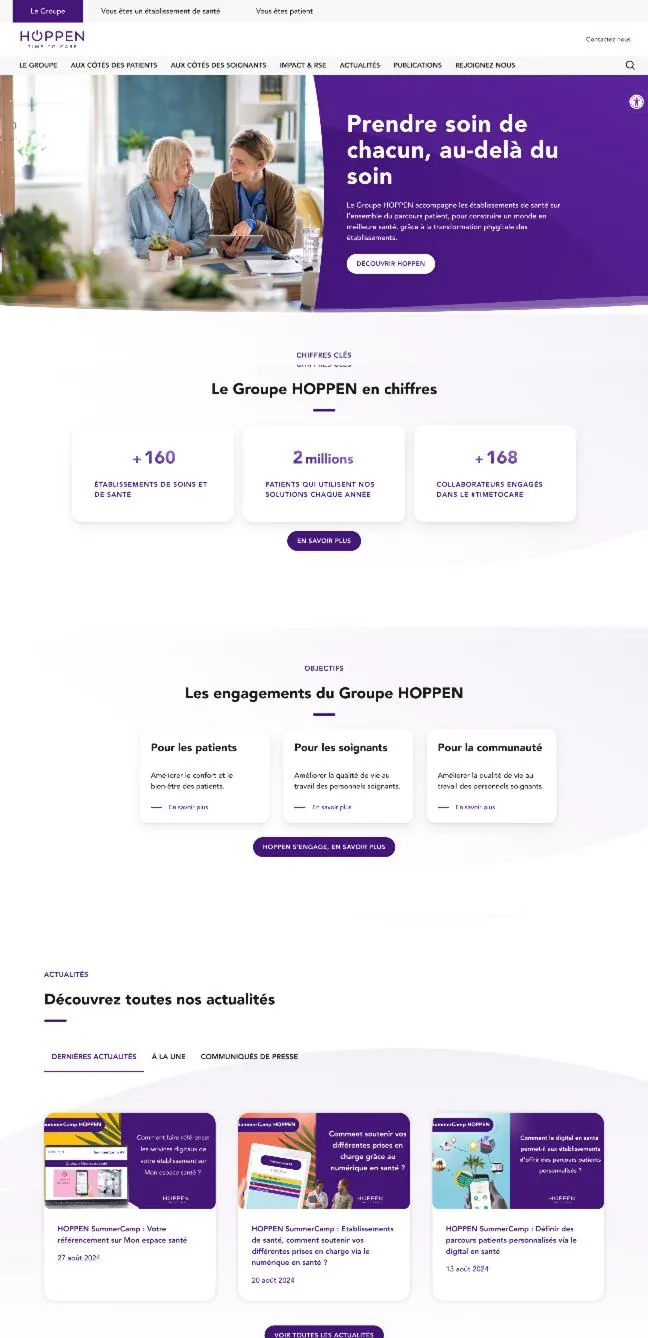
Hoppen: a services marketplace inside the hospital room
A phygital services marketplace deployed on-premise in HDS health-data infrastructure — 700+ hospitals, 150,000 screens, orders placed from the room or by relatives at a distance.

Overview
Hoppen is a leader in French e-health, equipping one patient in two: more than 700 healthcare establishments and 150,000 deployed screens. Around hospital care sits a layer of everyday services — hairdressing, flowers, press. Those services existed in hospitals. They were arranged informally, at the ward's discretion, with no consistent way to order them. Hoppen wanted them orderable: from the room, or by relatives at a distance.
Challenge
The dominant constraint is not commercial, it is regulatory. Anything touching hospital patient context in France falls under HDS health-data hosting rules, so a standard SaaS marketplace hosted wherever the vendor hosts it was not an option. The second constraint is that Hoppen already has an application ecosystem deployed on 150,000 screens; a marketplace that did not integrate natively with it would have been a second system for staff to learn. The third is physical: an order can be placed on a smartphone by a relative two hundred kilometres away or on a terminal in the corridor, and both have to draw on the same stock and the same provider schedule.

The marketplace had to live where the patient data lives, plug into what Hoppen already runs, and reconcile orders from very different places. Six elements make that possible.

The marketplace is deployed on-premise, inside HDS-compliant health-data infrastructure — a sovereign deployment rather than a hosted service. The regulatory perimeter of a clinical platform is respected by design, not by exception.
The platform is built API-first, so it integrates natively with the existing Hoppen applications rather than sitting alongside them. Staff work in one ecosystem, not two.
Identity is handled through Keycloak SSO. Users of the Hoppen ecosystem reach the services layer with the identity they already have — no second account, no separate directory.
Phygital reconciliation unifies orders placed from a relative's smartphone at a distance and from terminals in the establishment. Both draw on the same provider availability, with payments through Stripe, so the service does not break at the first collision.
Provider scheduling, dynamic commissions, CSV exports for accounting and a dispute module are handled in the platform. The operational side of a service marketplace is part of the product, not a spreadsheet next to it.
The build ran as hybrid co-development: the Second team delivered the MVP, then transferred skills to the Hoppen technical teams, who carry the platform forward inside their own ecosystem.
Hoppen extended a clinical platform into a transactional services layer without leaving the regulatory perimeter that clinical platforms have to stay inside — across more than 700 establishments and 150,000 screens.
Hoppen puts a transactional layer inside the clinical perimeter. Two Second modules carry it.
Industry use case: Healthcare →


Run a marketplace where providers sell services: availability, quotes, and payment tied to execution.
One place to source, compare and order services from approved suppliers, under agreed conditions.
Let members of a network find certified partners, compare them and make contact directly.
Turn customer requests into qualified leads: one quote request, or an RFx sent to several providers.
One structured catalogue: categories, attributes and pricing rules the operator defines.
Recruit, verify, structure and monitor the providers who sell through your platform.